


Table of Contents
A conversation between Brandon Cassagnol, Vice President of Portfolio Management, and Marina Salley, Head of Investor Relations
As an investor, you often see the finished result: beautifully designed homes in the most iconic destinations, ready for arrival and fully equipped for comfort. What you don’t always see is the work that happens behind the scenes. From acquisition to launch, and the ongoing effort required to maintain these homes over time.
To better understand the full process, our Head of Investor Relations, Marina Salley, sat down with the Vice President of Portfolio Management, Brandon Cassagnol to answer the questions investors ask most often. Their conversation focused on one of the newest acquisitions in Big Sky Resort, along with broader insights into how the portfolio operates across destinations like Lake Tahoe, Turks and Caicos, and Barcelona. It offers a detailed look at how homes are selected, upgraded, maintained, and positioned for long-term value.
Launching a Luxury Home in Big Sky:

Big Sky had quickly become one of the most talked-about acquisitions among our investors, and Brandon traveled to the residence personally to help oversee the launch process. Brandon explained that speed in delivering a home from acquisition to market plays an important role in making the business model work, but it must be balanced with the expectations of delivering a luxury experience.
“When you think about our business model, for it to work efficiently and for us to get the most value out of any investment we make into our homes, things need to happen rather quickly,” he said. “That typically goes directly against the other aspect of our business, which is that we’re promising a luxury product.”
Luxury, he noted, often requires careful planning. “Luxury sometimes means slow, methodical, very well thought through,” he explained. “So how do you combine efficiency with ultimately getting the best product out there for our investors and our guests to enjoy?”
The answer, he said, comes down to preparation and partnerships. “You have to have some really great partners,” Brandon said. “You have to have a wonderful set of vendors and suppliers to get a home up and running. You have to have a very intimate knowledge of both the local market and everything that goes into setting up a luxury residence.”
Shortly after closing the deal on Big Sky in October 2025, the process moved quickly. Furniture was delivered. Design plans were implemented. Linens and towels were ordered. A professional photographer was flown in from Colorado. Property management was secured.
“It was cool to see the team come together for a project like this,” Brandon said. Over the next several weeks, members of the Equity Residences team visited the home multiple times to confirm that everything met internal standards. “We had three Equity Residences team members visit in a matter of 90 days to make sure the home was up to snuff,” he said. “That the home was functional and living up to our standards.” By the end of that 90-day window, the residence was fully operational.
“Really, this whole process came together in about 90 days from closing,” Brandon explained. “All of that is to ensure our investors get the most value, both financially and from being able to enjoy the home at its full potential.”
Transforming the Home Through Strategic Upgrades
Marina reviewed the “before” and “after” photos of Big Sky, and the transformation created during the launch was immediately noticeable.
“There’s a huge difference,” she said. “How did you upgrade the house to look way better? What was the upgrade for this type of project?”
Brandon explained that while the home had strong fundamentals, it required updates to compete effectively in the market.
“In a home like this, which is a very classic mountain home, it also had some classic furnishings,” he said. “While those were tasteful, some maybe could have been justified to leave, we’re setting the home up to really set ourselves apart from all the other homes in the area.” That differentiation was necessary because many homes in the surrounding community shared similar styles.

“The community we are in is largely a planned community with very similar-looking homes,” Brandon explained. “When you’re in the short-term rental space, you quickly blend in. You become this homogenous blob of the same-looking inventory.” To avoid that outcome, the team focused on strategic improvements.
“So how do we set ourselves apart?” he said. “We make strategic upgrades to the finishes and fixtures in the house.” Partnerships played a role here as well. “This is why we partner with suppliers like Dahlgren Duck, who have connections to every major furniture supplier and mom-and-pop shop,” Brandon explained. “They help us get the best deal at well below retail pricing and deliver furnishings that are hospitality grade.”
The upgrades focused on key areas of the home. “Our approach was focused on the main living area, the dining room, the primary bedroom, and ensuring we created comfortable sleeping locations,” he said. Before renovation, the sleeping configuration was limited. “The home originally had one king bed, two full mattresses, another queen, no sleeper sofa, and probably slept eight people comfortably,” Brandon recalled.
After the redesign, capacity improved significantly.
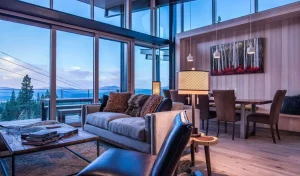
“With the changes we made, we now have three king beds,” he said. “We redid the bunk room and moved that upstairs to create a second primary suite on the ground level.” Additional updates focused on comfort and usability. “In the living room, we added a beautiful new sofa,” Brandon said. “One guest already commented that it was the most comfortable sofa they’ve ever sat on.”
Dining spaces were also reconfigured. “We took away a very dated square dining room table and replaced it with a round table,” he explained. “It’s much more conducive to things you do on vacation, like card games or hosting a party of ten.” The goal was to support the way investors and their families actually use the home.

“We try to take everything into consideration and accommodate as many different party dynamics as possible,” Brandon said. “We also made refreshes to our art and décor,” he added. “That’s the finishing touch that makes the difference between any home and a curated luxury experience.”
Why Big Sky Was Selected as an Investment Opportunity
After discussing upgrades, Marina shifted to another frequent investor question: how homes are selected in the first place.
“What do you know about Big Sky?” she asked. “How does it compare to other markets?”
Brandon explained that Big Sky stands apart from more established destinations such as Vail and Aspen. “Big Sky is a very interesting market,” he said. “It was originally labeled a failed development years ago, but if you were early in Big Sky, you’re feeling good about your investment now.”
What makes the market appealing today is its stage of growth. “The beauty of Big Sky versus Vail or Aspen is that it is not as established,” Brandon explained. In mature markets, inventory is often controlled by long-term owners. “In Vail Village, you can’t build new construction anytime soon,” he said. “You have a lot of legacy homeowners who have been sitting on their houses for 10, 20, or 30 years.” That structure affects pricing dynamics. “These are homes that get passed down from generation to generation,” Brandon said. “That creates a rental market where some owners are comfortable charging lower rates because their mortgage either doesn’t exist or their expectations are different.”
Big Sky offers a different opportunity. “It’s still very much a developing market,” he explained. “Buying ski-in, ski-out property at a premier mountain destination is near impossible–so finding a gem like this supports what’s most important to us, the potential for long-term appreciation.” Confidence in the market has also been reinforced by investment from major hotel brands such as Montage Big Sky. “Brands like that coming in suggest this was already a great,
What Performance Looks Like in a Mountain Market
After discussing why Big Sky was selected, Marina turned to another question investors frequently ask: performance expectations. Mountain destinations present unique challenges, especially when compared to year-round urban markets. “As far as cap rate goes, the mountains can be one of the most challenging types of vacation destinations to make something pencil for the way we operate our homes,” Brandon explained.
Weather also plays a major role “because you have very volatile ski seasons that are dependent on snow,” In addition to peak winter demand, mountain destinations experience predictable shoulder seasons. “You have very clear shoulder seasons, meaning there’s typically lower occupancy due to closures and weather. It’s not quite warm enough to hike, and there’s no skiing available.” he said.
Despite those seasonal realties, early performance in Big Sky shows encouraging signs. “The beauty of what we’ve seen in Big Sky,is a willingness to go and have a great time,” [in the moutains]. At the time of the discussion, booking had already exceeded expectations. “When we talk about occupancy, we’re already well north of 60 percent on the books for this year,” he said. “It’s also one of the leaders in our partner usage.” That level of interest confirmed what many investors had anticipated. “It tells us we probably want more mountain homes in the future,” he added. “The home is already exceeding expectations on that aspect of use and enjoyment.”
Big Sky has consistently ranked as one of the top destinations requested by Equity Platinum Fund 2 investors. “To fulfill that wish, some investors actually moved reservations from other mountain homes like Vail and Lake Tahoe to Big Sky,” Marina noted. “They want to visit the new destination.”

“It’s always exciting,” Brandon said, noting that the home’s ski-in, ski-out location places it within walking distance of the main attractions in the village. He noted that this part of Big Sky has a stronger local presence and more restaurant options, making it more convenient than areas such as Moonlight Basin, where getting to other dining or activities can require a 30- to 45-minute drive. He emphasized that the team feels very positive about both the location itself and the continued development and future investment happening around it.
Maintaining Equity Residences Homes
After discussing acquisitions and upgrades, Marina shifted to one of the most important questions investors ask: how homes are maintained over time, especially across very different locations and environments.The residences are ultimately sold after 10 to 15 years so the team needs to ensure that t each home remains in top condition throughout the ownership cycle.
Brandon explained that maintenance is constant. “The really short, simple answer is it’s all day, every day,” he said. He described the process as a dedicated effort led by an internal asset management team whose sole responsibility is to ensure every residence performs at its highest standard.“It’s not contractors, it’s not part-time,” Brandon said. “It’s an individual whose sole purpose at our business is to ensure that our homes are the best they can be.”
To maintain consistency, the team conducts regular site visits across the portfolio. During each visit, they complete a detailed 180-point inspection, a process that can take several hours and results in a comprehensive list of items that require attention. “We’re nitpicky, and we have to be,” Brandon added. This level of detail allows the team to address issues early and maintain a consistent standard across homes, regardless of location.
At the same time, not all portfolio residences face the same conditions. Marina pointed out that oceanfront homes in destinations such as Turks and Caicos and Costa Rica tend to require more upkeep, particularly due to their proximity to saltwater. Brandon confirmed that each environment presents its own challenges. Oceanfront homes are exposed to salt, humidity, and constant sun, all of which accelerate wear and corrosion. These homes require more frequent maintenance and a greater investment of time and resources.

“That’s what comes with the territory,” he said. “You have to be prepared to invest both time and money into these properties to ensure we get the most of them.”
Mountain homes, including those in Big Sky and Lake Tahoe, present a different set of demands. Winter conditions require ongoing snow removal and ice management, while seasonal use introduces additional wear. Skis, boots, and outdoor gear bring moisture, dirt, and salt into the home, impacting floors, walls, and finishes over time. Larger homes also involve more complex systems that must be monitored closely throughout the year.
Despite these differences, the approach remains consistent. “No matter if you’re in the mountains or on the beach, there are always considerations,” Brandon said. Maintenance decisions are always made with long-term ownership in mind. Whether evaluating materials, scheduling preventative servicing, or planning future replacements, the focus remains on protecting the property over many years. “It just comes down to living and breathing that every single day,” Brandon said. “And having an extremely dedicated team.”
How Strategic Upgrades Reduce Costs and Increase Property Value
Beyond routine maintenance, some projects focus on improving efficiency and strengthening long-term value. Marina introduced this topic by asking about capital projects, particularly solar installations in locations where operating costs continue to rise. Brandon described a recent example at a residence in Los Cabos, where electricity costs had increased significantly over time.
He explained that the local utility, CFE, has seen rates increase well over 100 percent in the past decade. Because the home is large and highly occupied, electricity usage remained high, making it a strong candidate for solar.
“There is no better candidate to start with for solar,” Brandon said.
The decision focused on measurable financial performance. Installing solar panels reduced energy expenses associated with operating a large home in a warm climate.
“The savings can be 60 to 70 percent in any given year,” Brandon explained. “And those are dollars directly back to our bottom line.”
Projects like this also add long-term value. Energy-efficient systems make homes more attractive to future buyers and can strengthen resale potential when the property is eventually sold.
Marina noted that these improvements serve multiple purposes, reducing operating costs during ownership while contributing to long-term real estate value. Brandon added that solar and similar upgrades are evaluated carefully and introduced where they make the most sense, particularly in warm-weather destinations where electricity usage remains consistently high. These types of investments reflect a broader philosophy: improvements should not only solve current challenges, but also position homes for stronger performance in the future.
Thinking in Decades, Not Months
As the conversation came to a close, Marina reflected on something investors often notice over time: the amount of planning that happens long before a home is eventually sold. She pointed out that while investors enjoy the homes during ownership, the long-term goal is always to protect and grow long- term underlying value so that when the time comes to liquidate, the investments are positioned to sell successfully.
Brandon explained that this long-term mindset shapes nearly every decision made across the portfolio. “When I think about Equity Residences, something that I take great pride in is we’re in it for the long haul,” he said. Rather than focusing on short-term results, the team evaluates each property based on how it will perform over the next decade or more. Improvements, maintenance, and operational decisions are made with the understanding that homes are typically held for 10 to 15 years.

“This is not short-term thinking,” Brandon said. “We have to think about the next 10 to 12 years, 10 to 15 years of this residence and how it can both be enjoyed and also protected.” That philosophy influences everything from material selections to capital improvements. Even when decisions require additional time or investment upfront, the focus remains on durability and long-term performance.
Brandon noted that the process can sometimes feel slow or painstaking, particularly when balancing the demands of luxury standards with operational efficiency. But he emphasized that careful planning ultimately delivers stronger results. “While it may be a little bit slower, maybe a little bit more painstaking, sometimes borderline annoying, it’s always worth it,” he said.
This disciplined approach is what allows Equity Residences’ portfolio homes to remain competitive in their markets over time. It also ensures that homes continue to meet investor expectations, not just in the early years, but throughout the full lifecycle of ownership. By thinking in decades instead of months, the team is able to protect the quality of each home while positioning it for long-term value. That long-term focus, Brandon explained, is what ultimately supports both enjoyment today and successful resale in the future.
Interview by Marina Salley, Head of Investor Relations for Equity Residences. To learn more about becoming an investor, contact info@equityresidences.com.
FAQs
Q: How does Equity Residences maintain its portfolio of homes to make sure homes are ready for investors and are ready for liquidation when the time comes?
A: Equity Residences maintains its portfolio through a highly hands-on, full-time asset management approach. A dedicated in-house team regularly visits and inspects each residence using a detailed 180-point checklist, ensuring every home meets strict quality standards. We invest heavily in this process, continuously expanding and developing our team as the portfolio grows. Given the complexity and uniqueness of luxury homes, success depends on skilled, detail-oriented professionals who can manage maintenance across different locations, systems, and cultural contexts—ensuring homes are always investor-ready and positioned for eventual liquidation.
The team also has preventative maintenance in place, for example servicing air conditioners regularly.
Q: Does Equity Residences invest in capital improvement projects like solar energy? Can you share an example?
A: Yes, we actively pursue capital projects where they make strong financial and operational sense—solar is a strong example. We recently invested in a solar installation at one of our homes in Los Cabos, where electricity costs from the local utility (CFE) have increased more than 100% over the past decade.
Because this is a large, high-occupancy residence with significant energy usage, it was an ideal candidate. The solar investment is expected to reduce electricity costs by approximately 60–70% annually, delivering meaningful savings directly to the bottom line.
Beyond the operational savings, solar also enhances the investment’s long-term value. It serves as a compelling feature for future buyers, making the home more attractive at the time of liquidation and providing an additional layer of return for investors.
Q: How does Equity Residences bring a home up to the standard investors expect after acquisition?
A: Equity Residences takes a highly strategic, design-forward approach to upgrading each home, focusing on both differentiation and functionality. In markets like Big Sky—where many homes look similar—the goal is to stand out by enhancing finishes, furnishings, and overall guest experience. This includes partnering with premium suppliers to source high-quality, hospitality-grade furniture at favorable pricing and ensuring timely installation.
Upgrades are targeted to the most impactful areas of the home, such as main living spaces, dining areas, and primary bedrooms.
Similarly, in destinations like Turks and Caicos, the focus is on aligning the home with luxury hospitality standards while maximizing appeal for both usage and resale. Across all portfolio homes, the objective is consistent: create a differentiated, high-quality experience that meets investor expectations, enhances rental performance, and positions the home competitively for future liquidation.


